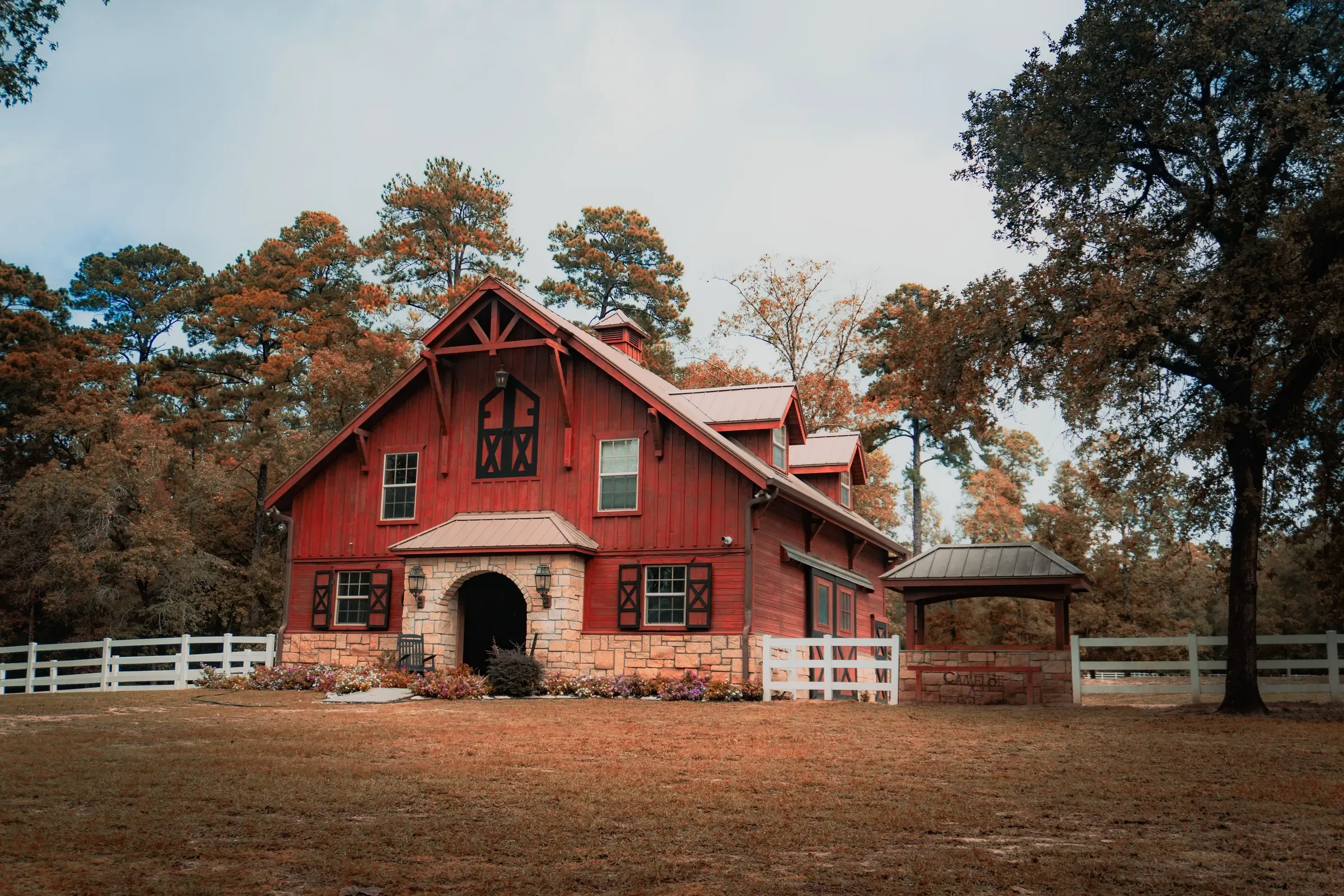

Barndominium and barn builders in Johnson City, Texas
Barn and barndominium builders around Johnson City are independent Blanco County contractors who work this ranch-and-wildflower country. Johnson City is the Blanco County seat and the gateway to LBJ country, where US-290 and US-281 cross at the northeastern edge of the Hill Country. Picture a metal home and a working barn on a few acres of oak and bluebonnet, within easy reach of both Austin and Fredericksburg. Blanco County ties the septic permit to subdivision platting, which is worth confirming before you buy.
Quote requests from Johnson City go to one independent builder that builds across the Texas Hill Country and the San Antonio and Austin areas. Who does what.
Building around Johnson City
Johnson City is named for the family of President Lyndon B. Johnson, and the LBJ Ranch and National Historical Park sit just west toward Stonewall. The town anchors the US-290 and US-281 junction, drawing ranchette buyers, wildflower-season visitors, and folks who want acreage within reach of both Austin and Fredericksburg. Barndominium homes and working barns lead the local building mix.
Barndominium builders in Johnson City, TX
Barndominiums and metal building homes lead, with equipment and hay barns common on the working ranches and the occasional horse barn. Its position between Austin and Fredericksburg brings some second-home and weekend-ranch buyers.
A barndominium general contractor around Johnson City is building in ranch-and-wildflower country at the US-290 and US-281 junction, often for a buyer who lives in Austin during the week. Custom-built metal homes with a working barn beside them are the usual project, and post-frame construction covers both. Blanco County ties the septic permit to the plat, so the contractor should confirm the tract's platting status before construction is scheduled, and a turnkey quote should spell out the septic, the well and the electric line extension separately from the building.
Permitting in and around Johnson City
Inside the City of Johnson City, city building permits apply. Out in unincorporated Blanco County, there is no general building code, but the same county rule applies as around Blanco: the septic permit is tied to subdivision platting, and the county will not issue it for a lot in a subdivision without an approved, recorded final plat. Confirm platting before you buy. The Blanco County permitting page has the details.
Site notes for Johnson City land
The land here is Hill Country ranch country on the Trinity aquifer, thin soil over limestone. Plan an aerobic septic unit, budget for a limestone well drill, and engineer the building for roughly 105 to 115 mph design wind, more on the exposed ridges and hilltops.
Registering a well with the Blanco-Pedernales district
All of Blanco County sits inside the Blanco-Pedernales Groundwater Conservation District, whose office is on West Main Street in Johnson City. Under the district's rules (effective April 16, 2026), the owner of a new well must register it before drilling begins, and that registration is also the request for drilling authorization: the district signs off once the form is complete, the fee is paid and the proposed spot passes the spacing rule. Its fee schedule (effective October 1, 2025) charges $500 to register any well drilled after February 11, 2002, while an older well registers at no charge. A well for a home, livestock, poultry or wildlife that cannot produce over 25,000 gallons a day, about 17.36 gallons a minute, needs no operating permit. Go over that, or change what the water is used for, and the well needs one, at a $3,000 application fee. The owner must see that the driller's State of Texas Well Report reaches the district inside 60 days of completion.
Rule 4.2 sets the gaps by pumping capability. A well at 17.36 gallons a minute or less sits 100 feet from any registered well and 50 feet from each property line; from 17.37 to 50 gallons a minute it is 300 and 150 feet, and the distances keep growing from there. A tract whose shape or geology will not allow those gaps can ask for a variance, and unless the land was subdivided before February 11, 2002 or the well replaces an old one, the owner must send notice of the request to each affected neighbor by certified mail. A replacement well does not have to keep the gap from the well it replaces. Separation from septic tanks, drain fields and other contamination sources follows the state water well driller rules, 16 TAC 76.1000.
City water and sewer, and the line a private well cannot cross
The City of Johnson City holds water certificate No. 10441 and sewer certificate No. 20159 from the Public Utility Commission, both amended in PUC Docket No. 55711 (service area maps dated October 31, 2024). That boundary matters on land just outside town, because the district's Rule 4.2.D keeps every new private well at least 50 feet outside the service area of a retail water utility. To drill inside the area, an owner needs a variance, backed by proof that the utility will not or cannot serve the tract, or that the well is exempt under Texas Water Code 36.117(b).
The city will not simply run a line out to a new rural customer either. A note in its fiscal year 2027 fee schedule says rates for accounts outside the city limits apply only to grandfathered accounts, and that customers outside the city's certificated area must be annexed before connecting. For a new home that does connect, the schedule lists $1,627.81 to tap a 3/4-inch meter with up to 60 feet of service line, $1,398.49 for a sewer tap plus the actual cost of the connection work and any road repair plus 10 percent, and impact fees that start at $3,210 for water and $4,745 for sewer on a 5/8-inch meter. So for a tract at the edge of town, ask City Hall at (830) 868-7111 whether the parcel falls inside the city's service area before you decide between a well and a city tap.
A building permit inside the Johnson City limits
The city's permits page names Bureau Veritas as the building official: the firm does the plan review and inspections for homes and commercial buildings, while city staff take applications and book inspections, which must be requested by 4 p.m. for the next business day. Building inside the corporate limits must meet the 2015 International Residential Code and the other 2015 codes the city lists. A home application includes a plot plan at one inch to 20 feet, an energy compliance report, stamped engineered foundation plans, and engineered plans for the driveway approach and drainage culvert. A drive onto a state road, which includes US 290 and US 281 through town, also needs TxDOT review. A form survey is due before the plumbing rough inspection.
The residential permit fee is charged per square foot of everything under roof, counting living space, the garage and covered porches and balconies, at a per-foot rate that steps down as the total grows, from $2.45 on the smallest projects to $0.80 above 5,000 square feet, and residential plan review adds 35 percent of the permit fee. That matters on a barndominium, where the shop bay and a deep porch can rival the living area. A detached barn or shop goes through the accessory building process: an application, a site plan with distances to property lines and other buildings, and a plan set, or the maker's brochure for a prebuilt kit. A single-family home gets a building final instead of a certificate of occupancy. Where a lot touches a mapped floodplain, the city's floodplain development permit is $378 and an elevation certificate $157.07.
Get a free quote for your Johnson City project
Tell us about your project. Your details go to one independent builder, who can schedule a free consultation or quote. No cost, no obligation.
Thank you. Your request is in.
The builder will reach out about your project. You can also call (830) 272-7461.
Johnson City building questions
Do I need a permit to build a barndominium in Johnson City?
Inside the City of Johnson City, yes, through the city. In the unincorporated county, there is no general building code, but you need the septic permit, and Blanco County ties that to subdivision platting, so your lot must be properly platted. Check the Blanco County permitting page.
Is Johnson City a good base for a weekend ranch?
Many buyers think so, because it sits at the US-290 and US-281 junction within reach of both Austin and Fredericksburg. That access is part of why barndominiums and weekend ranches are popular here. A local builder can help you plan a low-maintenance build for part-time use.
Before I buy a Johnson City lot, what should I check?
Start with the plat. In Blanco County the septic permit is tied to subdivision platting, so the county will not permit a septic system for a lot in a subdivision without an approved, recorded final plat. Confirm that before you close. Then check the practical questions: an aerobic septic system on limestone soil, a well budget for a limestone drill, and any deed restrictions on a metal building. Our land feasibility checklist covers the full list, and it is far cheaper to check now than after closing.
Who builds in Johnson City?
An independent local builder who works in Blanco County and provides the quote.
Updated