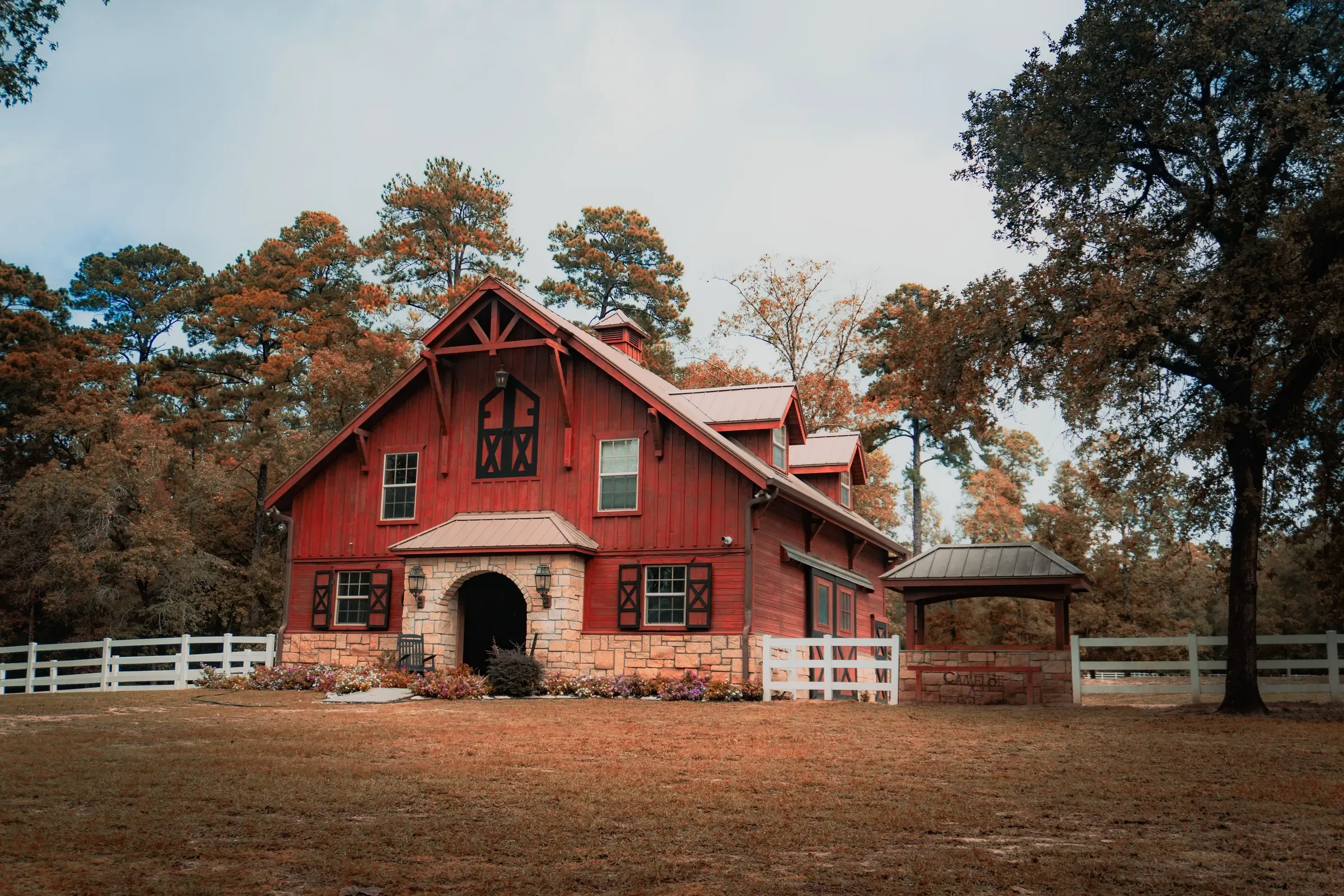

Barndominium and barn builders in Bandera, Texas
Barndominium and horse-barn builders in Bandera are independent Bandera County contractors who build for equestrian land. Bandera bills itself as the Cowboy Capital of Texas, and the building reflects it: stables, run-in sheds, covered arenas, and barndominiums on acreage along the Medina River. Picture a center-aisle barn with living quarters at one end, a covered arena to ride out of the sun, and horses turned out on the cedar-covered hills.
Quote requests from Bandera go to one independent builder that builds across the Texas Hill Country and the San Antonio and Austin areas. Who does what.
Building around Bandera
Bandera is the seat of Bandera County, set on the Medina River with dude ranches, working horse operations, and ranchettes spread through the cedar-covered hills. Buyers are often horse owners, trainers, and folks who want a piece of the cowboy lifestyle on acreage. That makes the local building mix distinctly equestrian compared with the rest of the Hill Country.
Barndominium builders in Bandera, TX
Horse barns and riding arenas lead here in a way they do not elsewhere, often paired with living quarters that make the project a barndominium. Equipment and hay barns are common on the working places, and standalone barndominiums round it out.
Barndominium construction in Bandera usually starts with the horses. A Bandera County contractor who builds center-aisle barns and covered arenas can add living quarters to make the project a barndominium, and a general contractor who builds custom metal homes can add the stalls. Post-frame construction is the common choice for both. Turnkey quotes here should separate the barn, the arena cover and the finished living space, because the living space is where the cost per square foot climbs.
Permitting in and around Bandera
Inside the City of Bandera, city permits apply. Out in unincorporated Bandera County, there is no general building code, so the septic permit governs anything with plumbing, run through the County Engineer under the county OSSF Order that adopts the state rules. A plain horse barn or hay barn with no plumbing usually needs no county building permit; add a wash rack, bathroom, or living quarters and the septic permit applies. The Bandera County permitting page covers it.
Site notes for Bandera land
Bandera land is largely thin soil over limestone on the Trinity aquifer, so wells can be deep and septic is usually an aerobic unit. A large covered arena is a tall, wind-catching structure, so engineer it for the roughly 105 to 115 mph design wind, more on exposed ground.
Registering a well with the Bandera County district
The Bandera County River Authority and Groundwater District, at 440 FM 3240 in Bandera, covers the whole county. Under its Chapter 36 rules (amended October 17, 2024), every new well is registered or permitted with the district before drilling, and whether a house well can simply be registered turns on the date the land was platted. On a tract platted before September 1, 2002, a household or livestock well that cannot make more than 25,000 gallons a day registers at any tract size. Platted from September 1, 2002 through August 31, 2022, the tract must be 5 acres or more; platted on or after September 1, 2022, 10 acres or more, and a second registered well needs another 5 or 10 acres in turn. A smaller tract needs a full permit, which goes before the district board and carries an annual pumping limit. Either way the tract cannot already have a working well, and an abandoned well on it has to be plugged first.
The fee schedule linked from the district's permitting page (effective October 23, 2023) lists $500 to register a well, $1,500 for a permitted well and $100 for a variance. The application asks for the Bandera CAD property ID and a copy of the deed, and an approved registration is good for 90 days, with one 90-day extension. Rule 6.1 keeps an exempt well 50 feet from the property line and 100 feet from existing wells, and the registration form has the owner confirm 50 feet from a septic tank and from the absorption field or spray area, and 150 feet from a river, stream or lake and from any livestock enclosure. On a horse property, that means staking the well before the barn, the pens and the arena. The district sets a numbered marker in the well's concrete slab, and the driller has 60 days after completion to file the well log.
Building near the Medina River outside the city limits
Outside any incorporated town, flood rules come from the Bandera County Flood Damage Prevention Court Order, adopted April 9, 2020 as the minimum standard for new construction and substantial improvements. The county's development permit application (revised January 8, 2025) will not proceed without a 911 address, wants an area map or survey and the deed, and asks whether water comes from a private well and sewage goes to an on-site system. For a site in an identified flood hazard area the applicant hands in a copy of the plans, and inside a delineated floodway a "no-rise" letter, signed and sealed by a licensed professional engineer, certifying the project will not raise the base flood elevation. The county's fee sheet (revised February 2024) prices the application at $50 for a residential project and $400 for a commercial one.
Where the maps give a base flood elevation, Article 5, Section B of the order puts the lowest floor of a new home, basement included, at or above it, certified to the floodplain administrator by a registered engineer, architect or land surveyor. A barn, shop or other nonresidential building either meets the same height or is floodproofed watertight below it, on an engineer's or architect's certification. An enclosed space under the lowest floor used only for parking, storage or access has to let floodwater through: two or more openings on separate walls, one square inch of opening for each square foot enclosed, the bottom of each no more than a foot above grade. The septic system is tied to it as well, because a lot inside the special flood hazard area needs a final foundation elevation certificate before the county issues the license to operate the OSSF. The County Engineer's office is at 1212 Hackberry Street, second floor, (830) 796-3175.
Inside the City of Bandera: permits, water and sewer
The city's permitting page says its permit jurisdiction ends at the city limit line, sign permits aside, while Bandera mailing addresses run well out into the county, so check the parcel before deciding whose rules apply. Inside the limits, every contractor registers with the city first, with state ID, any state licenses that apply and a certificate of liability insurance; a pre-application meeting is required for all new construction; and plans can go to a third-party reviewer, which takes at least 10 business days and is billed to the owner at cost. The 2026-2027 fee schedule (effective October 1, 2026) charges $0.60 per square foot of project for a new home and $400 for the new-construction inspection, and work begun before the permit is picked up draws an investigative fee of twice the permit fee. Under the place-type zoning map adopted November 16, 2021, an owner-occupied lot in the P3 Neighborhood zone may have one bunkhouse behind the main house.
City water and sewer reach only the city limits and part of the ETJ, the utilities page says, and no property in Lakehills, Pipe Creek or Medina. For a lot the city does serve, the same schedule lists $1,800 for a 3/4-inch water tap, $1,800 for a 4-inch sewer tap out of a manhole plus $210 a foot where the manhole runs deeper than 8 feet, and a $150 deposit inside the limits or $200 outside; a tap in TxDOT right of way is priced per job. New utility rates take effect October 21, 2026. Beyond the city's area, the house well goes through the district above, and the Texas Water Development Board's water service boundary viewer shows whether a retail water supplier covers the parcel.
Get a free quote for your Bandera project
Tell us about your project. Your details go to one independent builder, who can schedule a free consultation or quote. No cost, no obligation.
Thank you. Your request is in.
The builder will reach out about your project. You can also call (830) 272-7461.
Bandera building questions
Do I need a permit to build a horse barn in Bandera County?
A plain horse barn with no plumbing usually needs no county building permit in the unincorporated county, since Bandera County does not inspect general building there. Add a wash rack, bathroom, or living quarters and the septic permit applies, through the County Engineer. Inside the City of Bandera, city permits apply.
Can I build a covered riding arena on my Bandera property?
Usually yes on acreage. The main considerations are engineering the large clear-span roof for Hill Country wind, footing and drainage, and water and electric. A builder who does arenas can size it to your discipline and engineer it for the site.
Will a barn with living quarters finance and appraise in Bandera County?
It can, but plan for two wrinkles. A barn with attached living quarters is a barndominium for appraisal and lending, so you want a construction-to-permanent loan from a rural or farm-credit lender that understands the type, and you should expect the appraisal to lean on comparable sales that can be thin. On the land side, a wash rack or living quarters triggers the septic permit, and thin Trinity-aquifer soils usually mean an aerobic unit plus a limestone well drill. The financing guide and the land feasibility checklist cover both.
Who builds horse barns in Bandera?
An independent local builder who builds for horse properties and provides the quote.
Updated